
The Problem of Beginning

How does the process of musical composition begin? This is both a practical and psychological question. Often, the hardest part is simply getting started. Once you're underway, composing can feel procedural, as if the musical material tells you what you need to do.
Artistic inertia is entangled with fear, agency and subjectivity. So it's understandable that a composer might try to find a way to spark a beginning, for it's often easier to respond than to initiate.
In this post, I want to talk about a way of using computers that can help us begin composing. Composing with computers means many things today. Here, I'm focussing on computer-assisted algorithmic composition (CAAC), which is a way of using algorithms, or sets of structured rules, to support compositional creativity.
But what is a rule? I want to think of it not as a stricture, but as an enabling condition or 'environment' that channels a kind of musical 'energy'. Western musical notation works this way, letting us represent and shape musical ideas according to its conventions.
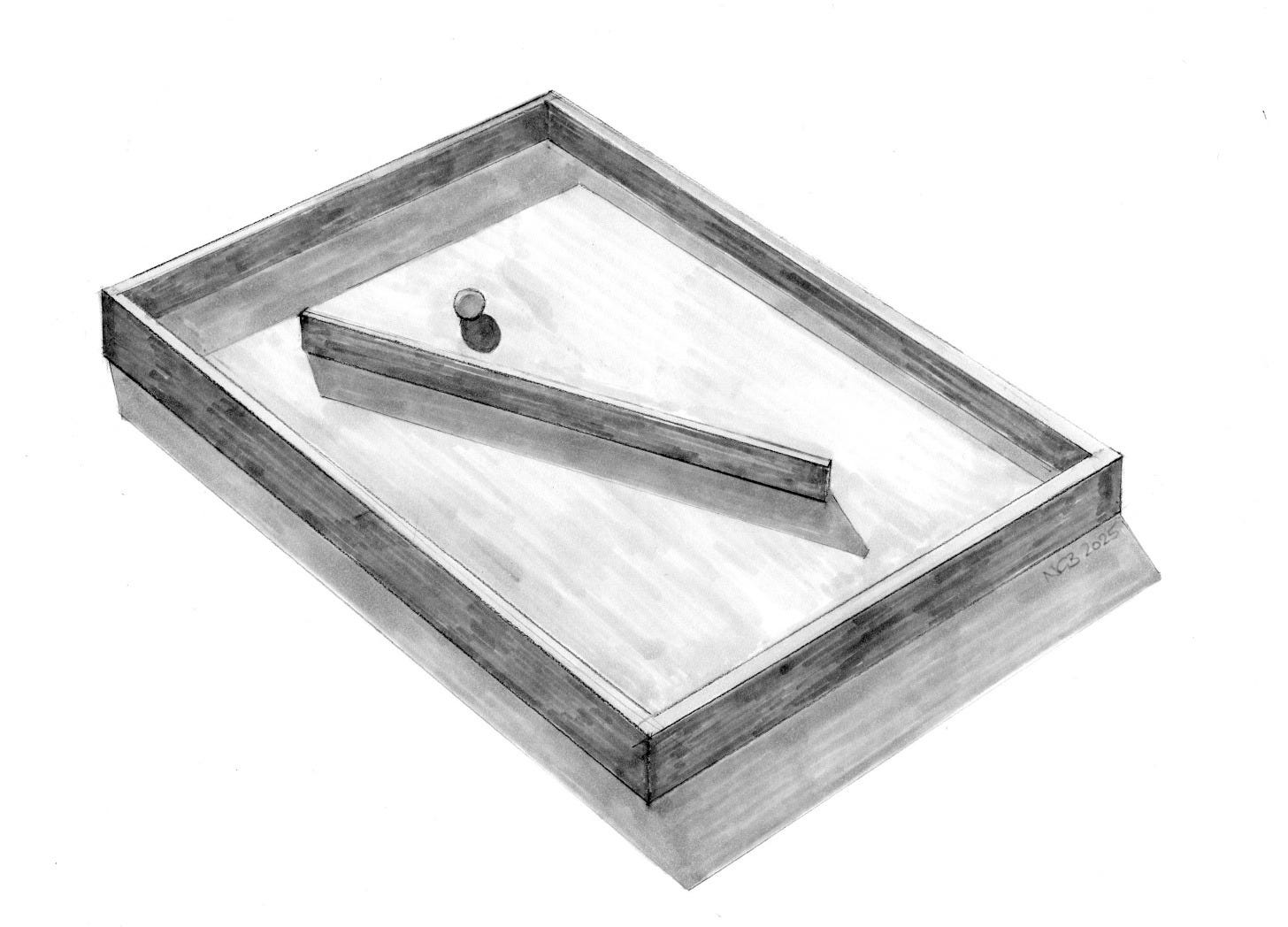
To begin composing, we need ideas and gestures. Once these are ‘in play’, our composing becomes a job of directing their momentum. Think of it like one of those games with a metal ball trapped in a wooden maze. When you tilt the tray, the shiny silver ball rolls and skids across the wooden surface. Your task is to guide it through the maze, feeling the weight of the tray in your arms.
The physical nature of a metal ball carries with it the possibility of wobbling unpredictably on a tilted wooden surface. Without some guiding rail, the ball is difficult to control. This is a little like the problem of artistic agency, when the need to act stirs uncertainty, self-consciousness or inhibition. You need a supporting structure. So you fix a strip of wood at an angle inside the tray.
Now, when the ball hits this fence, you direct its movement along the trajectory of the strip. The fence doesn’t merely redirect. It makes it easy for the ball to move on a new heading, its guidance creates new possibilities. This altered trajectory reveals further possibilities: should it change direction again and veer elsewhere?
This analogy between ball and composition suggests that composing means introducing an element into a musical world in a way that allows the composer to shape how the composition unfolds. Musical creation may begin with a gesture that gives shape to a composition precisely because that gesture already carries the potential of what might follow. It's a seed. Once the work starts unfolding, composing becomes a matter of attuning the senses—listening for latent possibility, attending to the morphology of sonic gestures, querying how they might transform over time.
This way, the choices a composer makes start to take on a cumulative effect, which we might call style. The composer attends to a musical gesture and senses possible futures. The creative question is whether to comply or resist. Do you contrast thick, cloth-like textures with narrowband, ribbon-like sounds? Do you maintain that woolly density? Composing is about calibrating the interrelationships between gestures, always in relation to the developing character of the work, its evolving environment.
Let's return to the start. Sometimes it feels like, if only the play would begin, it would be easier to keep playing. So if the flow comes as a style emerges, if progress follows attuning to gestures and if environments can be shaped by rules, then how do you come up with a rule?
This is where computers can help if we let them become partners in developing compositional environments. Computers are useful for generating opening gambits if we tell them the kind of game we want to play. They act on input, seeding environments with the potential for internal consistency that can be shaped by the sensibility of a human composer.
In this way, a computer, as a generative tool, opens the possibility of a dialogue. What's interesting is that this challenges the boundary between tool and collaborator. The subject of the dialogue is the composition—the environment you want to shape. When you pass a rule to a computer, you go some way toward prefiguring the kind of composition that will emerge as you shape the gestures it generates.
You might start with an aesthetic impulse—a musical gesture that has some quality of restriction. You select an algorithm in the form of a computer function, perhaps a random walk, which instructs the computer to output a series of musical notes over time.
You add constraints to narrow its expressive scope: make sure no note is more than a minor third from the previous one; avoid notes outside the range of a violin (G3 and higher); bias the melody towards hovering around A4 for 60% of its duration.
Finally, you run your code. The computer executes the algorithm and generates the melody. Now it's over to you. You attend to its musical nature, make ‘composerly’ decisions in response to it, consistent or otherwise with its nature, thus maintaining the overall integrity of the developing composition.
This is one approach to composing with computers and it’s by no means the only kind of algorithmic composition. It is a pathway to musical creativity, aided by computational procedure. There is plenty of room for intuition, hunch and experience. In a sense, the computer presents a puzzle that calls upon your musicality—your sensitivity to what's presented and your agency in responding to it.